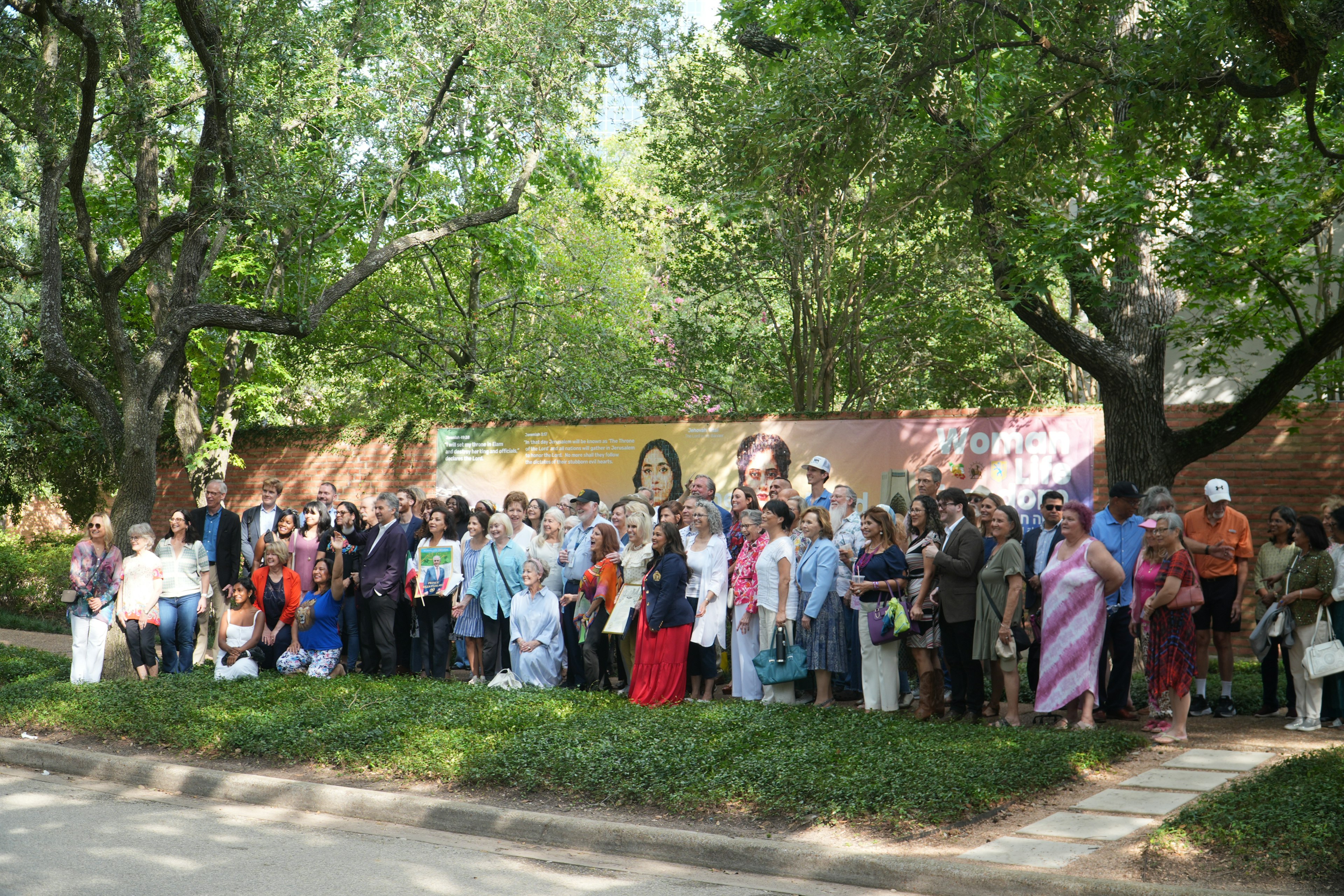
Note – Recently, I had the honor of speaking at the American unveiling of Hooman Khalili’s powerful “Woman Life Freedom” mural at Rice University. Below is the speech I delivered, reflecting on themes of interfaith solidarity, global human rights, and the inspiring legacy of Queen Esther.
Good afternoon everyone,
It is a pleasure to stand before you today at the unveiling of my friend Hooman Khalili’s powerful mural here at Rice University, where I have served for ten years in the Department of Sociology.
For me, this artwork is more than just quotes, colors, and tiles. It is a profound statement on interfaith solidarity and the enduring fight for global human rights.
As a Catholic, myself I believe it is my sacred duty to stand up for righteous causes. My faith, which is rooted in the teachings of Jesus, calls me to be an instrument of compassion, justice, and peace. Christians are reminded in Proverbs (31:8-9) to, “Speak up for those who cannot speak for themselves, for the rights of all who are destitute. Speak up and judge fairly, defend the rights of the poor and needy.” This is precisely why I wholeheartedly supported Hooman Khalili’s mural from the very beginning.
The “Woman Life Freedom” mural pays homage to two extraordinary women who embody the themes of “resistance” and “resilience.” Behind me, we see the faces of Shirel Haim-Pour and Mahsa Amini, who Hooman honored with his previous words. They represent countless individuals around the world who are fighting for their freedom and fundamental rights. Their stories are a testament to the indomitable human spirit that refuses to be silenced, even in the face of inhumanity.
Shirel and Mahsa’s stories, though different, resonate with a universal yearning for both dignity and freedom. Overriding their individual narratives is the powerful Biblical symbol of Esther, the Jewish woman who became the queen of Persia during the reign of Xerxes I, who ruled from 486 to 464 BC. Xerxes, if you are not aware, was a Zoroastrian.
Esther had an interesting rise to her position as Queen. The Bible tells us that Esther was an orphan and raised by her cousin, Mordecai, in Persia. Prior to Esther’s rise, Xerxes is reported to have banished his former queen for perceived wrongdoings, and he then proceeded to hold a “beauty contest” to find his next wife. Xerxes ended up choosing Esther, who was known for her beauty. However, as the new queen, she never told Xerxes that she was Jewish. She kept her identity a secret, likely out of fear that her ethnicity and religion would be a problem for the all powerful Xerxes.
Another character in the story, whose name was Haman, was a high official of Xerxes. He had plotted to annihilate all Jews across Persia. Esther’s guardian and cousin, Mordecai, learned of Haman’s sinister plot and urged Esther to intervene. Intervening was an act requiring immense courage, as approaching King Xerxes without being summoned could mean harsh punishments. It also took a tremendous amount of courage for Esther to reveal her true identity to the king.
In the face of her predicament before raising these issues to the king, Esther famously declared, “If I perish, I perish.”
In the next part of this Biblical story, Esther famously invited Xerxes and Haman to a banquet where she courageously revealed Haman’s wicked plot. Xerxes, after hearing Esther’s case, sided with her cause. Haman, in turn, received capital punishment for his treachery, and Esther and Mordecai secured a royal decree allowing the Persian Jews to defend themselves. This deliverance of the Jewish people from annihilation is still celebrated today in the festival of Purim.
Esther’s resilience was not just about bravery, it was about a “strategic wisdom,” and her story is not merely a historical account, it is a timeless call to action. Think about it, a Persian Zoroastrian, Xerxes, stood up for the rights and lives of the Jewish people, even going against his own advisors who were asking him to do the exact opposite. This is the very essence of interfaith solidarity – defending people’s dignity and rights, regardless of their faith or background, and recognizing our shared humanity.
By placing the great Esther as an overarching symbol, Hooman Khalili’s mural compels us to consider our own roles. As a Christian, I am called to love my neighbors as myself (Mark 12:31) and to be a peacemaker (Matthew 5:9). To my Jewish and Persian friends here – you are indeed like neighbors and I extend my love to you as you have done with me, and even more than this, know that I and other Christians like me are dedicated to the “good fight” in the struggle for genuine peace, where Jewish and Persian people can be at ease and thrive in the many societies in which they reside.
As I wrap up, I hope this mural serves as a source of inspiration. Let it remind us all of our shared responsibility to speak truth to tyrannical powers and to actively work towards a world where freedom is upheld for the righteous.
Thank you very much and God bless.
 craigconsidinetcd.com